

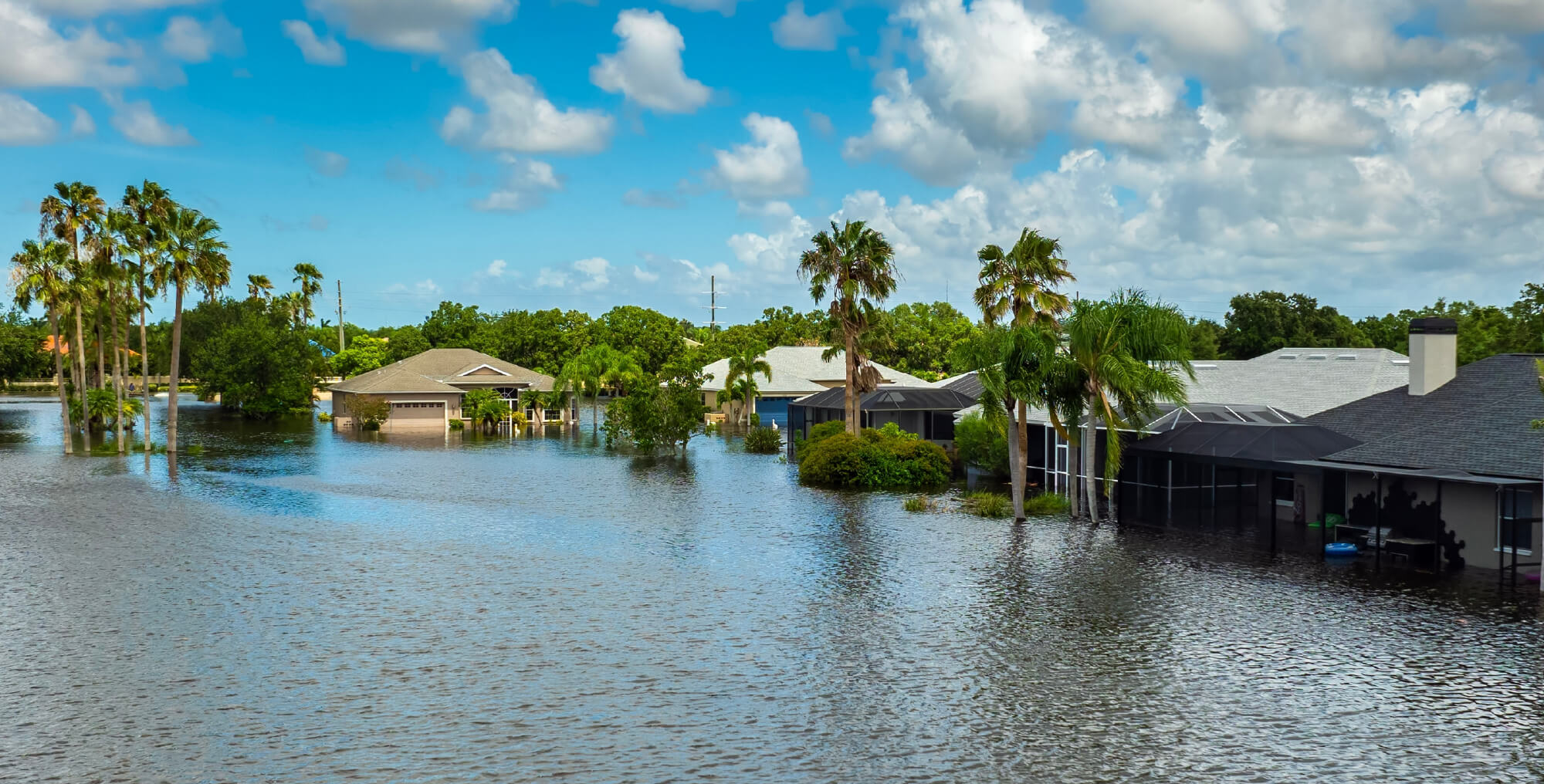
Florida flood insurance is one of the most misunderstood topics in the state’s insurance market — and one of the most financially consequential. Homeowners assume their standard policy covers storm flooding. It typically does not. Renters assume their landlord’s policy covers their belongings. It does not. Business owners assume their commercial property policy responds to rising water. In most cases, it does not.
This guide covers what Florida homeowners, renters, condo owners, and business owners may want to know about flood insurance heading into the 2026 Atlantic hurricane season: what it costs, how NFIP and private flood options differ, why waiting periods matter, what policies may and may not cover, and what steps to consider before June 1.
Florida Flood Insurance Is Separate from Your Homeowners Policy
The single most expensive misunderstanding in the Florida insurance market is the assumption that homeowners insurance covers flooding. Standard HO-3 homeowners policies exclude flood damage — including storm surge, rising water, tidal overflow, and rainwater that pools and enters a home from the ground up.
A simple test: if the water touched the ground before it entered your home, it is generally considered a flood event. Wind-driven rain through a damaged roof is typically a homeowners claim. Water rising through a floor or flowing in from outside typically is not.
The Florida Office of Insurance Regulation and FEMA’s FloodSmart.gov both spell this out clearly. Flood coverage must be purchased separately, either through the National Flood Insurance Program (NFIP) or a private flood insurer. For a detailed look at how flood claims actually work, including what adjusters look for and where coverage gaps tend to appear, see our post The Hidden Realities of Flood Insurance for Homeowners.
The 2026 Hurricane Season Forecast and Florida Flood Risk
Colorado State University’s April 2026 forecast calls for 13 named storms, 6 hurricanes, and 2 major hurricanes — a somewhat below-average season driven in part by a developing El Niño. AccuWeather forecasts 11 to 16 named storms with 3 to 5 direct U.S. impacts, naming Florida’s coastline among the higher-risk regions.
The practical takeaway for Florida homeowners: below-average forecasts are not a reason to delay flood coverage decisions. The 1992 season produced just seven named storms, one of which was Hurricane Andrew. The 2024 season brought Hurricanes Helene and Milton, which together caused more than $130 billion in combined damage and directly affected Comegys’s Tampa Bay clients. Recent research also indicates that the strongest Atlantic hurricanes are intensifying more rapidly than previous generations, meaning storms can reach major intensity faster than forecast models once suggested.
One storm, arriving faster than expected, is all Florida flood exposure requires.
How Much Does Florida Flood Insurance Cost in 2026?
Florida flood insurance costs vary significantly based on flood zone, home elevation, foundation type, distance to water, and coverage limits. The statewide average through the NFIP is roughly $760 to $850 per year, but that figure tells you very little about what any specific property will cost.
A more useful frame is flood zone:
- Zone X (minimal to moderate risk, outside the 100-year floodplain): typically $400 to $1,200 per year. Many Zone X properties may qualify for NFIP’s lower-cost Preferred Risk Policy.
- Zone AE (high-risk, inside the 100-year floodplain): typically $1,500 to $4,000+ per year for most Florida properties, with some coastal locations higher. A Zone AE property carries roughly a 1% annual flood probability, which translates to approximately a 26% chance over the life of a 30-year mortgage.
- Zone A (high-risk without a detailed elevation study): similar range to AE, typically $1,200 to $8,000+ per year.
- Zone VE (coastal high-velocity wave action): typically $3,500 to $15,000+ per year, with direct beachfront properties often at the higher end.
If your NFIP premium has increased significantly in the last few years, you may be experiencing FEMA’s Risk Rating 2.0 — a pricing overhaul fully implemented in 2023 that replaced the legacy system with property-specific variables, including replacement cost value, distance to water, flood type, and first-floor height. Federal law caps most annual NFIP increases at 18 percent per year under a gradual “glide path” toward risk-based pricing.
Private flood insurance now holds roughly 27 percent of the Florida flood market. For newer, elevated, or well-mitigated homes, private options may be 10 to 30 percent less expensive than NFIP for comparable coverage — though pricing varies by carrier and property, and some high-risk coastal properties may find NFIP more competitive. Comparing both options through an independent agent is generally the most effective way to find the right fit.
The Florida Flood Insurance Waiting Period: Why June 1 Is the Deadline That Matters
Most new NFIP flood insurance policies do not take effect for 30 days after purchase. A policy bound on June 2 may not be active until July 2. By then, the Atlantic hurricane season is well underway, and binding new coverage once a storm is named or a cone appears typically becomes much more difficult.
There are limited exceptions: policies tied to a mortgage closing, an increase in a loan amount, or a FEMA flood map revision may carry shorter or no waiting periods. For most voluntary purchases, the 30-day window is firm.
Private flood insurance policies often carry shorter waiting periods — commonly 10 to 14 days — though waiting periods and binding moratoriums vary by carrier and circumstances. This can be a meaningful advantage for homeowners purchasing coverage close to or during hurricane season.
The practical implications:
- If you do not have Florida flood insurance today, you may already be outside the safe window for the first named storms of the 2026 season.
- Once a tropical system is named and a cone appears, new flood coverage options narrow quickly.
- Waiting until August or September — the statistical peak of hurricane season — to review flood coverage is generally too late to act without a gap in protection.
If you don’t have a Florida flood insurance policy in place, request a quote from Comegys today or call (727) 521-2100. Every week matters.
NFIP vs. Private Florida Flood Insurance: Which May Be Right for You?
Florida homeowners have two main pathways for flood coverage: the federally administered NFIP and the growing private flood market. Each has meaningfully different limits, features, and pricing structures.
NFIP at a glance:
- Residential building coverage up to $250,000; contents coverage up to $100,000
- Standardized policy form and claims process
- 30-day waiting period for most new purchases
- Contents coverage pays actual cash value — meaning depreciation is factored in, not full replacement cost
Private flood insurance at a glance:
- Higher coverage limits — up to $4 million on building and $500,000 on contents with some carriers
- Shorter waiting periods — often 10 to 14 days
- May include additional living expenses (ALE) if a home is uninhabitable — NFIP does not
- Replacement cost contents coverage available with some carriers
- Competitive pricing for newer, elevated, or lower-risk properties
As an independent agency, Comegys quotes both NFIP and private flood options side by side. For a full breakdown of how the two compare — including specific scenarios where each may be the stronger fit — see our post NFIP vs. Neptune: What’s the Difference?.
What Florida Flood Insurance May Cover — and Where Gaps Often Appear
Understanding what a flood policy may cover before a storm is the difference between a smooth claim and months of frustration. Coverage varies between NFIP and private carriers, so the following is a general overview — always refer to your specific policy for exact terms.
What building coverage may include:
- Foundation, walls, floors, electrical, and plumbing systems
- HVAC equipment, water heaters, and built-in appliances
- Permanently installed cabinetry, paneling, and flooring
Common coverage gaps to be aware of:
- Temporary housing / additional living expenses — not included in NFIP; may be available through some private carriers
- Vehicles — covered under auto comprehensive, not flood insurance
- Outdoor property — most fences, decks, pools, and landscaping are excluded
- Business income / loss of rents — requires separate coverage
- Valuables — NFIP caps artwork, jewelry, and collectibles at $2,500 total; consider scheduling high-value items separately
Contents coverage under NFIP pays actual cash value — depreciation applies. Private flood carriers may offer replacement cost contents coverage, which pays the full cost of replacing damaged items with new equivalents. For a deeper look at how flood claims actually work, see our post The Hidden Realities of Flood Insurance for Homeowners.
Florida Flood Insurance for Renters, Condo Owners, and Landlords
Flood exposure extends well beyond homeowners. Every Florida resident who lives in a structure that can flood has potential financial exposure.
Renters:
A landlord’s property policy does not cover a tenant’s belongings, and a standard renters insurance policy typically excludes flood damage just as homeowners policies do. NFIP offers contents-only flood coverage for renters — often available for $100 to $300 per year in many Florida zones. For anyone renting at ground level in Florida, it is worth a conversation with an agent.
Condo owners:
Flood coverage for condos operates in two layers. Your condo association typically carries a master flood policy on the building structure and common areas. Everything from your drywall in is generally your responsibility. Review your association’s master
policy carefully — paying attention to the master deductible and what loss assessment coverage applies — then purchase an individual unit flood policy to address any gap.
Landlords:
If you own rental property in Florida, building coverage on the structure is your responsibility — tenants are responsible for their own contents. Consider whether your policy also addresses loss of rents during the potentially extended vacancy that follows a major flood, a feature more commonly available through private flood carriers than NFIP.
Florida Flood Insurance for Business Owners
Commercial flood exposure is larger and more complex than residential, and the coverage gaps tend to be more financially significant. Standard commercial property policies generally exclude flood damage — exactly as residential homeowners policies do. Flood coverage must be purchased separately.
The NFIP commercial flood program offers up to $500,000 in building coverage and $500,000 in contents coverage per building. For most Florida commercial properties — retail centers, office buildings, medical facilities, warehouses, multifamily buildings — that limit may not be sufficient. Excess flood insurance, placed through private surplus-lines markets, can extend total coverage into the millions and typically attaches above the NFIP layer at a competitive additional cost.
Business interruption coverage also deserves attention. Standard commercial BI coverage generally requires direct physical loss from a covered peril to trigger — and because flood is excluded from most commercial property policies, BI may not respond to a flood loss at all without a specific endorsement or separate policy feature. Florida business owners should confirm with their agent exactly what triggers their BI coverage and whether flood is included.
For a broader look at commercial hurricane preparedness and the current Florida business insurance market, see our posts Hurricane Season Is Coming — Is Your Business Coverage Ready? and Florida Businesses Brace for Hurricane Season as Insurance Confidence Falters.
Elevation Certificates and Your Florida Flood Insurance Rate
An elevation certificate is a document prepared by a licensed land surveyor or engineer that records your property’s elevation relative to FEMA’s base flood elevation. Under FEMA’s current Risk Rating 2.0 system, elevation certificates are technically optional for NFIP rating — but they remain valuable in two specific situations.
First, if FEMA’s modeled elevation data for your property is incorrect — and it sometimes is — an elevation certificate showing that your actual first-floor height is higher than FEMA assumes may meaningfully reduce your NFIP premium. Second, most private flood carriers still use elevation heavily in their underwriting. An elevation certificate demonstrating that your home sits well above the base flood elevation often unlocks more competitive private quotes.
Elevation certificates typically cost $300 to $600 in Florida and are completed by a licensed surveyor. For any property in Zone AE, A, or VE, obtaining one before renewal is generally worth considering. Send a copy to your Comegys agent and we can re-quote your policy across every carrier we represent.
FEMA’s Florida Flood Map Updates: Is Your Zone Still Accurate?
FEMA updated flood maps across large sections of Florida during 2024 and 2025, redrawing Special Flood Hazard Areas to reflect updated storm surge modeling, rainfall data, and sea-level rise projections. Thousands of Florida properties were remapped into higher-risk zones — meaning mortgage lenders may now require flood insurance where they previously did not.
If you purchased your Florida home before 2023, your current flood zone designation may differ from what you were told at closing.
You can verify your property’s current designation at the You can verify your property’s current designation at the FEMA Flood Map Service Center. If your property has moved into a higher-risk zone, you may qualify for NFIP’s “Newly Mapped” rating, which phases in premium increases gradually. If you’ve moved into a lower-risk zone, you may be eligible for a reduced premium — but you typically need to ask. A Comegys agent can review your current designation and re-quote accordingly.
Should Florida Homeowners in “Low-Risk” Zones Consider Florida Flood Insurance?
FEMA estimates that a significant share of flood claims nationally come from properties outside designated Special Flood Hazard Areas. In Florida, Zone X, B, and C properties — areas considered lower risk — face real exposure from heavy rainfall, overwhelmed drainage infrastructure, and hurricane rain bands that can push water miles inland. Flood insurance premiums in these zones are generally lower than most homeowners expect, which changes the cost-benefit calculation considerably. For a full look at why lower-risk Florida homes may want to consider flood coverage, see our post Why Low-Risk Florida Homes May Still Benefit from Flood Insurance.
Talk to Comegys Insurance Agency Before Hurricane Season Starts
Comegys Insurance Agency has been helping Florida families and business owners navigate flood coverage in St. Petersburg since 1939. As an independent agency recognized for four consecutive years among the 100 Largest Agencies in the USA by Insurance Journal Magazine, we represent dozens of carriers — including both NFIP and leading private flood insurers — so we can put the best available options in front of you in a single conversation.
The window for getting Florida flood insurance in place before the 2026 hurricane season is narrowing. The time to compare options, check flood zone designations, and confirm coverage limits is before the first named storm of the season — not after.
Request a free flood insurance quote online, explore our full product lineup, or call our St. Petersburg office at (727) 521-2100. Our licensed Florida flood insurance agents are available Monday through Friday, 9 AM to 5 PM.
Disclaimer: This article is for informational purposes only and does not constitute legal or insurance advice and is not a guarantee or offer of coverage. Coverage availability, terms, limits, and pricing vary by carrier, policy, location, and applicable law. Comegys Insurance Agency is an independent insurance agency offering access to multiple carriers and coverage options. For guidance on your specific situation, consult a licensed insurance professional at Comegys Insurance Agency.
About the Author: Derek Berset


